Mohammad Nourani sketches a portrait of the ambiguities of the US and Israel’s 40-day war on Iran through conversations with Tehran-based artists Nima Fasih, Hanane Jalou, Mahmoud Mokhtari, and Ameen Moazami.
While ‘Act I’ served as a meditation on the art objects that populate the author’s home, ‘Act II,’ centers on conversations between Nourani and the artists who made them: artists whose relationships to their homes—as places where they not only live but also produce their work—shifted dramatically in the wake of the war.
‘Act II: Last Year, Best Year,’ grew out of Fāsh’s desire to preserve, however modestly, something of the experience of our colleagues in Iran during the war. That said, we were equally interested in accounts that did not assume the conventional form of an artist’s presentation of their artistic practices. Instead, the artists featured in ‘Act II’ (Ameen, Hanane, Mahmoud, and Nima) become characters within Nourani’s short story—a story that, in many ways, mirrors and preserves his own life as well as the lives of its characters, while offering a glimpse into the broader experience of artists living and working in Tehran.
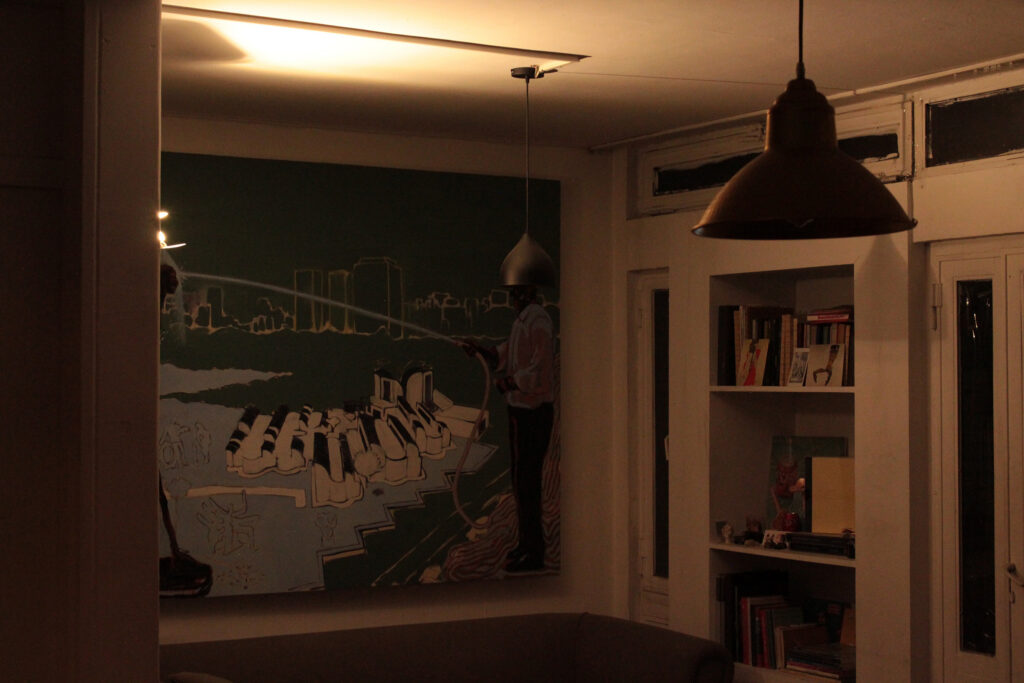
The first person I went looking for was Ameen. On one of the last days of Farvardin [April], I slung my backpack over my shoulder and went to his house. His chestnut-coloured beard had grown only a little longer. We embraced. In the living room, we sat with our feet carelessly propped up on the sofa, our backs to a large painting. The painting showed someone holding a hose over a bronze sculpture by Alberto Giacometti. In the background, the Museum of Contemporary Art and all of Tehran were being swept away by water.
I showed him the photographs I took of the objects at the house I rented from Hajji along with my notes, telling him about my idea for “Rearranging Reality.” I said I had pinned the photographs to the wooden mirror by the entrance and looked at my reflection standing beside them every day. As Ameen looked at each photograph, he would recall memories and laugh. After all, he had lived in that house for three years too. He said my idea was not nearly as unique as I thought, and that anyone would remember things from their past simply by looking at the objects around them.
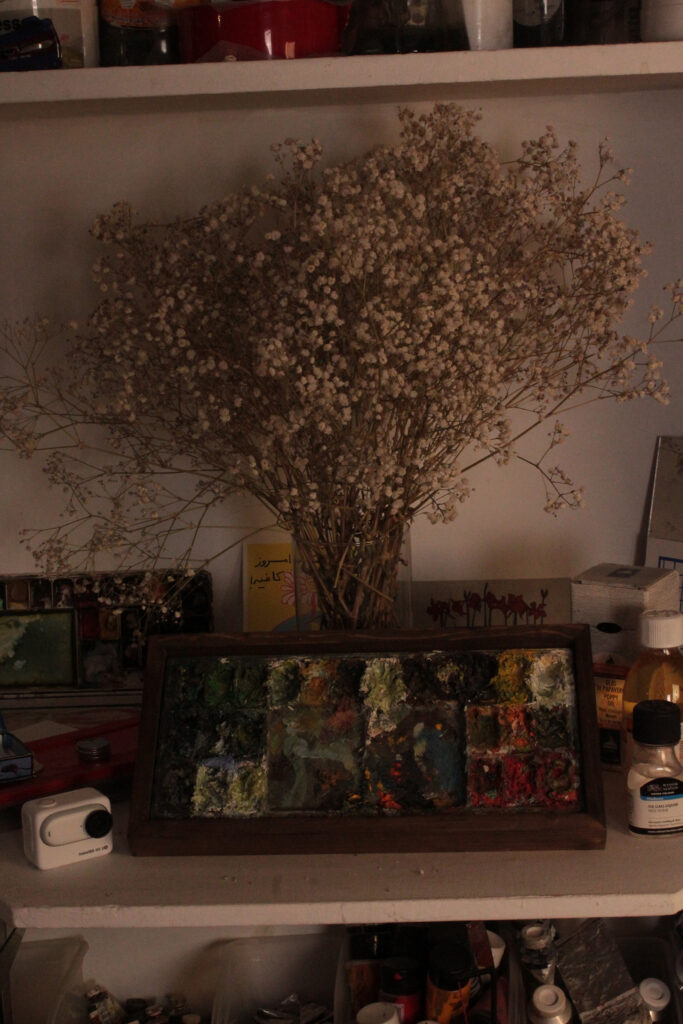
For instance, after seeing the mat in the corner of the living room, along with the rings and pull-up bar hanging from the kitchen doorway, he remembered that he used to exercise at home almost every day. The notes and sketches scattered across the table in the middle of the living room reminded him that the Rijksmuseum in Amsterdam, as well as several American libraries and universities, had bought his manual prints. The gifts and objects lining a shelf on the wall brought back memories of friends whose names he still couldn’t remember. And when he saw the painter’s palette on the shelf, framed like a museum artefact, he remembered how much he used to paint in the streets.
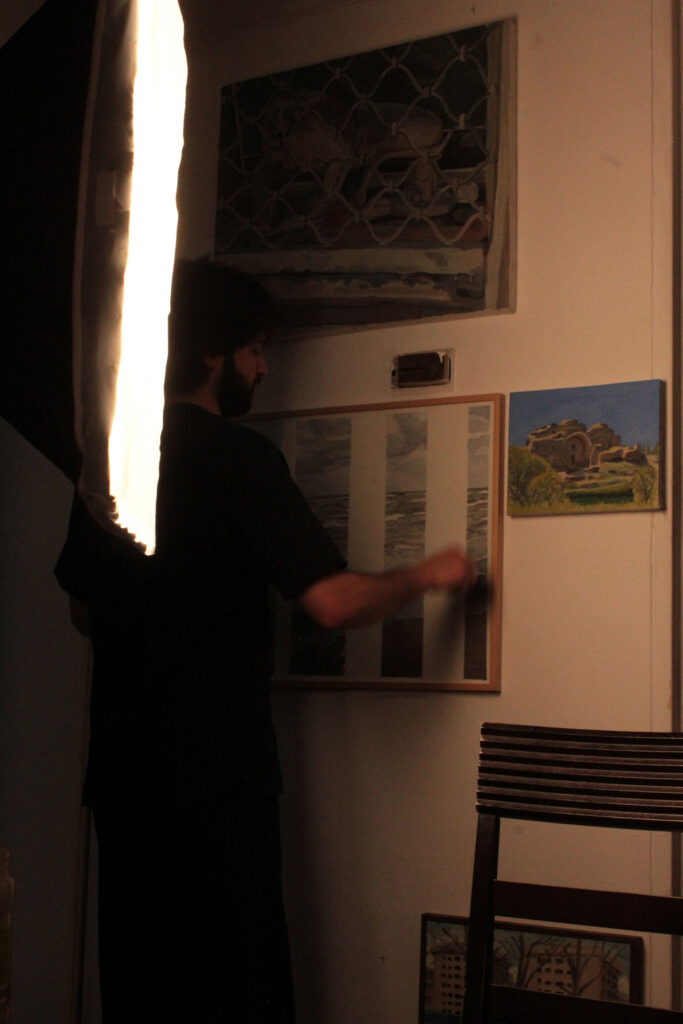
Ameen’s paintings, large and small, covered every wall of the living room, kitchen, and bathroom. Then, I asked, “Didn’t any of your paintings bring back any important memories?”
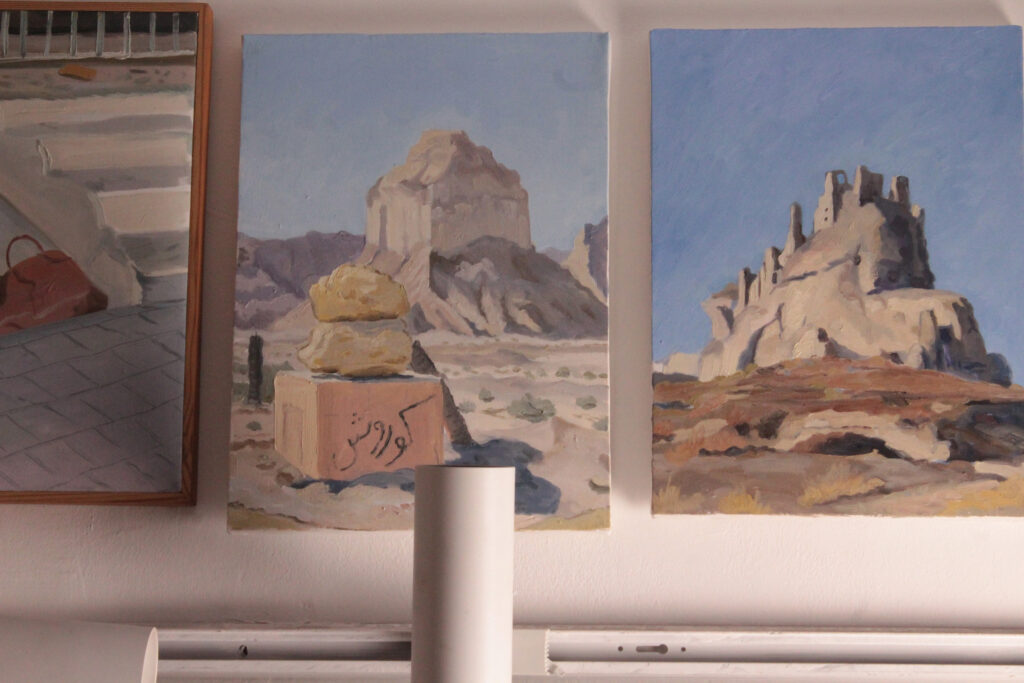
“They did,” he said, “especially the one I painted in Qeshm—the tomb of Cyrus.” He pointed to a painting of a mountain on the opposite wall. “Last year, I went to Marvdasht first to paint Cyrus’s tomb, but they wouldn’t let me take my painting equipment inside!” It seemed that, for some inexplicable reason, painting Cyrus’s tomb had been banned. “I decided to head to Qeshm. Qeshm is home to a valley of small mountains, ‘Valley of the Statues;’ one of which looks a lot like Cyrus’ tomb. So much so that someone decided to spray-paint the name, ‘Cyrus!’, on the concrete block right beside the mountain — ostensibly because both the shape of the block and the mountain had also reminded this person of Cyrus’ tomb. So, I said to myself, ‘From now on, this is Cyrus’s tomb for me!’”
“Negar and I,” I told Ameen, “are really trying to remember our forgotten feelings. Don’t you have this problem?”
“Actually, I do!” Ameen replied. “I have a painting of a single streetlamp on Keshavarz Boulevard that I painted on Yalda Night [Shab-e Yalda]. I remembered that I had a girlfriend at the time, and I thought we were going to spend Yalda Night together, but she had made plans with her own friends and hadn’t invited me. I felt lonely, so I grabbed my things and went to Keshavarz Boulevard. The boulevard had a really strange feeling to it. It was full of lonely people. I found this one very red lamp and painted it. That painting is really emotional for me. It’s like—that’s what loneliness is like! It’s okay to be alone! It’s okay! I had forgotten that I could actually cope with my loneliness like that.”
That Ameen was so casual when speaking about his memories bothered me. After all, nothing about our lives resembled an ordinary human life anymore. I wanted to understand how his life had managed to remain on its normal course.
As though he had read my mind, Ameen said, “When you decide to be an artist, you’re always in a state of war. So I guess my work and life haven’t changed all that much.” I asked, “Don’t you remember the day the war started? Or the day before?”
Ameen replied: “The first war, I was at a rave until ten in the morning, and we were relieved that the police weren’t coming anymore. We danced and… then we all went to Mashhad together.” I was only just beginning to remember! This was the same day when Hasti’s mother had washed the rug in the bathroom the night before; the same night during whose following day I had gone looking for Ameen, and, together,fled Tehran. “With this war, I had my motorcycle test, and the war started nearby. I was the first one in line. I took the test, and this time I passed. I came outside. I was heading home from Pasteur Square when they started bombing!”—Ameen’s house is near the intersection of Hafez and Somayeh Streets. “It had turned into a madhouse. It was terrifying. Everyone was rushing around, and they’d blocked off the streets. Buses were flying past at full speed.”
I remembered that, on that very day, instead of waking to the sound of explosions, I had been jolted awake by a call from Negar. Within minutes, the phones and the internet had been cut off. The final blow came when I started the car and was met with silence instead of the familiar call to prayer, Quran recitation, or news reports. All I could hear from the radio was the static of white noise. It felt as though, at last, the entire structure had collapsed—a moment that very few people on Earth ever get the chance to experience.
Lost in these thoughts, I didn’t notice how Ameen arrived at this memory: “I don’t remember the day the cloud formed at all. I just know that since I woke up, I haven’t messaged any of my exes. I don’t even remember their names.” And the two of us fired out the laughter that had been gathering on our lips for a few seconds. It was this kind of laughter that brought us closer than anything else.
“Ameen, don’t you remember your dream? I mean, the one you had after the black cloud!”
For a few moments, Ameen said nothing. It was as if he wanted to admit that his life, contrary to appearances, wasn’t entirely under his control. Then, as though trying to hide something, he hurriedly said: “Yeah, I remember some of it! I was on the road the whole time. I remember I had tons of motorcycles. I even had a boat and an airplane. I was always painting and seeing my friends. It was pretty much like my life right now. Except it felt like I was always looking for something that I could never find. I don’t remember exactly what it was. It was like I was afraid I had Alzheimer’s.”
“Oh, by the way, did you find that wooden picture frame?” I narrowed my eyes, and he realized that I had no idea what he meant. “Come on, that frame with the four pictures! I really loved it. I looked everywhere for it, but it wasn’t at my house! I thought maybe it was at Haji’s house.” After counting every single object in the house and all the notes I had left on them, I could say with complete certainty that there was no way such an object could possibly be in the house.
Now that the conversation had turned to the objects in the house, I thought it was a good opportunity and took the insect-eater statue out of my backpack. I held the shattered pieces of the statue’s face in my palm, right in front of Ameen. “Does this remind you of anything? I think it fell because of the blast wave. Its face is all smashed up.” Ameen went to the bathroom and gagged several times. From behind the door, he shouted: “Hanane and Nima brought that with them. Why don’t you ask them? And get rid of this piece of shit. Bury it.”
Hanane and Nima! Friends I hadn’t heard from in years. Ameen didn’t have their numbers. I went back home and took my old phone out of the dresser drawer. I couldn’t find their numbers, but there was a message from Mahmoud asking me to meet him at Artists Park.
On 7 March 2026, for the first time in the history of modern warfare, population-wide cognitive suppression systems were deployed. The media initially presented it as an unprecedented climatic event. Even after it became clear to everyone that what had happened was an American-Israeli weapons experiment, they referred to it using reassuring terms such as “multi-stage cloud seeding” and “atmospheric instability engineering.” When parts of classified CIA documents concerning an operation known as “Operation Eclipse” were declassified, it became clear that what had taken place over the skies of Iran was a combined operation involving cognitive weapons testing and media manipulation. Their aim was to erase painful memories of the past from the minds of Iranians, alongside the seemingly targeted assassinations.
In the early hours of Sunday morning, fighter jets released an extremely thick layer of flammable particles and aerosols of unknown origin into the skies over Iranian cities. Within hours, dense clouds of smoke spread across the blue sky like ink stains, plunging the day into absolute darkness. Soot and bits of charred material rained down from the clouds, steaming as they hit the ground. The clouds rapidly spread in every direction, reaching remote villages and distant cities as well. Inhaling the gas produced by the fallout, or coming into contact with it through the skin, caused brief confusion and headaches, eventually leading to a prolonged sleep. People who woke up after a day or two could remember little of their memories. All of the brain’s cognitive and motor functions remained intact, but for several months, the retrieval of autobiographical memories was impaired in more than ninety million people—something that was made to seem ordinary and temporary on television, under labels such as “mass Korsakoff syndrome.”
This apocalyptic spectacle, broadcast to the world for three straight days, became the most-watched news coverage of the twenty-first century. The anchors went back to work, reassuring everyone with simple phrases like “the forgetting cloud” and “the memory fog,” and the history of this country was once again turned with weary indifference, page after page.
On 7 Ordibehesht [27 April], I met Mahmoud at Artists Park. It hadn’t even been three months since I’d last seen him, but it was obvious that his hair and mustache had grown ever whiter and that his cheekbones were more pronounced than before. Even when we had been roommates, his body seemed to age by a year every month.
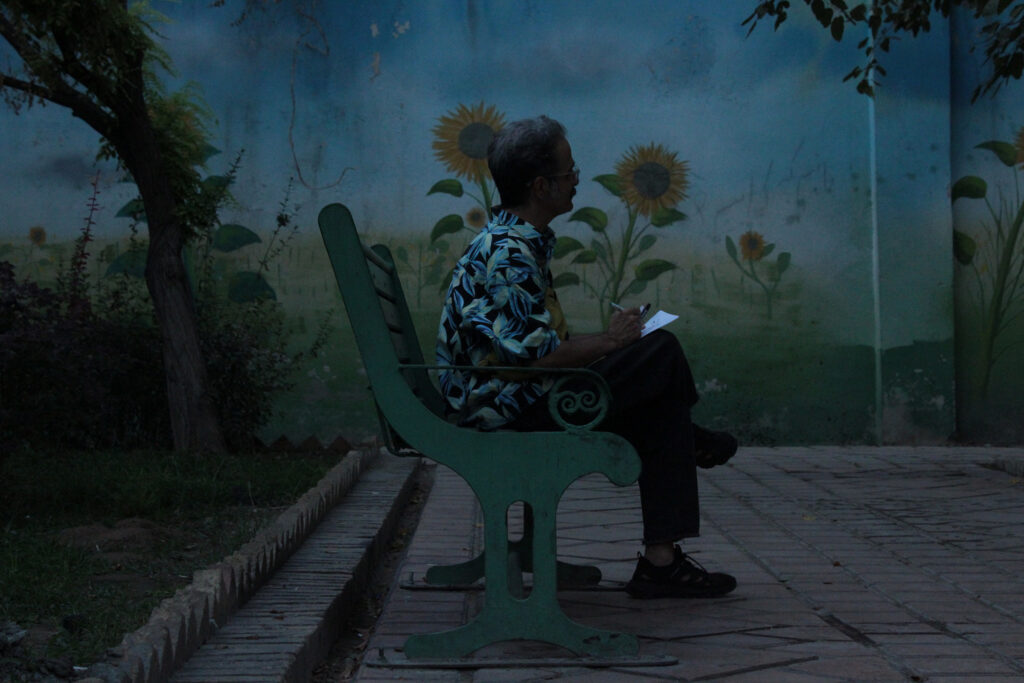
I hugged him and bought two paper cups of tea from the kiosk in front of the park. At Mahmoud’s suggestion, we sat on a platform. In front of us was the children’s playground, and two or three cats wandered around beside us. Children and cats were the two things that connected Mahmoud to life. Everything about that Monday afternoon had been arranged for Mahmoud’s performance.
He was delighted by how crowded the park was that day. He said that during the first days and nights of the war, he had hardly seen anyone else in the park. He remembered fragments from the previous year. As he recalled it, he had returned to Tehran like a child who was angry at his mother, with nowhere else to go, and had become my roommate. He remembered leaping off the sofa in his room in the mornings like a champion, going to CrossFit classes, or perhaps some other kind of exercise. Maybe he had gone to the teahouse in front of the Argo Factory to have an omelet for breakfast. He remembered that he had once asked about the working conditions at the teahouse. He also had a hazy image of the students in his illustration classes, gathering in the upper floor of a cafe in the evenings. But he couldn’t remember any of their names. He remembered that he had started teaching the classes again after several years of living in Qom, but he couldn’t remember why he had exiled himself to Qom.
He clearly remembered walking at night as far as Artists Park or Keshavarz Boulevard, but couldn’t remember why he went out walking every night. He remembered putting his earbuds in and roaming the streets, but didn’t know why, whenever he reached Keshavarz Boulevard, he would settle down like an impatient child in his “cradle.” He said that somehow, over the years, something had made Artists Park and Laleh Park into his “temples.” I wondered why Mahmoud didn’t consider anywhere his home. Mahmoud completed the thought for me with a joke, saying in English, “I’m not homeless. The streets are my home.”
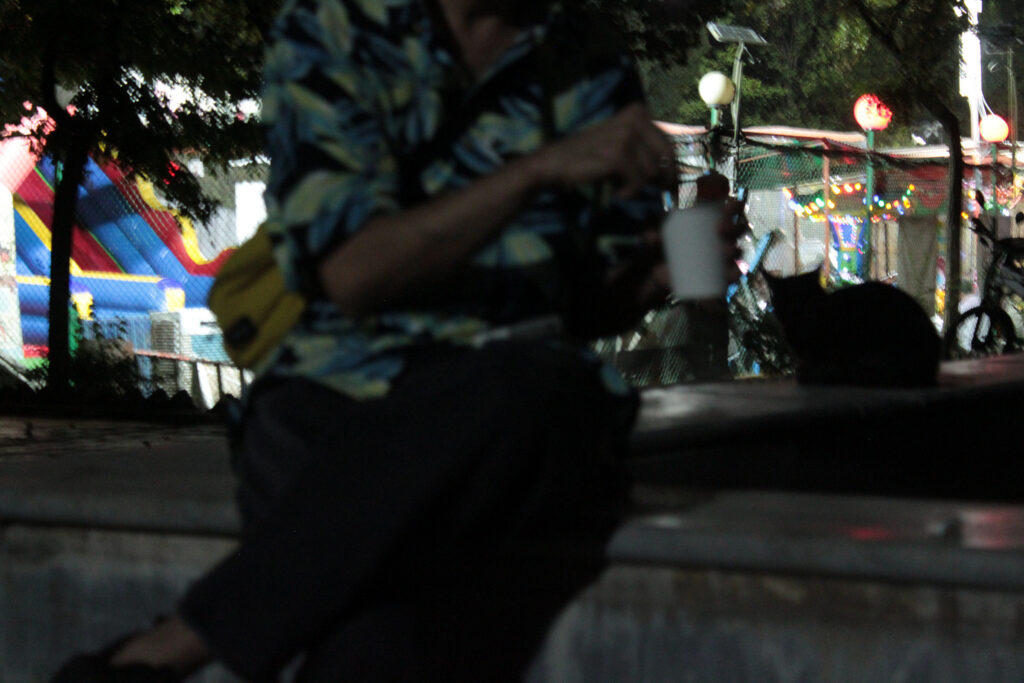
At last, I had a chance to tell him about my idea of “rearranging reality.” He nodded with complete concentration, holding back his usual jokes.
I asked, “Mahmoud, isn’t there any object that’s really precious to you, or that brings your memories back to life?”
He said, “The most important thing to me is my earbuds. I was pretty attached to my brush pen too. They were always with me. In the middle of the war, when my friends insisted that I go to Anzali for a few days, I took them with me. I took paper and a pen too, so I could work there. But what happened was, there, just like when I come to Artists Park, I would only go to the pier. My friends pushed me and said, ‘Go sit there and draw the pier itself, make some sketches, so you can break through this block.’ Because ever since one winter day—I don’t even remember exactly what happened—I haven’t been able to work. I’m completely paralyzed now. I mean, my brain and my hands just shut down. I’ve done a few scattered things that don’t really count as work, but I tried so many times and quickly destroyed the paper, tore it up. Even around Nowruz when I tried, again at my friends insistence, to paint some eggs, I would crush them in my hands and throw them away. I don’t know why I became like this. I remember I used to be someone who felt awful if I didn’t work for a day.”
I took a postcard out of my backpack and showed it to him. “Do you remember this?”
He said, “How could I have forgotten it? This is by far my best-known and most popular work! It was one of those ideas that just bubbled up in the moment, completely improvised. I only had watermelon on my mind. I wanted to make some sketches and turn a character into a watermelon, or a watermelon into a character. I arrived at the idea of putting a watermelon man face-to-face with his lover. The watermelon man is shown in profile; he has taken a slice from the red part of his face that looks like a smile and placed it on his lover’s face. The law of nature is that if you want to add something to one thing, you have to take it away from another. So ‘Mr. Watermelon’ has taken a smile from himself and put it on his lover’s face. On the surface, he has lost something of himself, but there are now two smiles.”
I remembered that Mahmoud never told anything from his own point of view. He loved playing with concepts and watching other people’s lives, turning them into thoughts and ideas.
“Where did you go during the war?”, I asked.
“I mostly stayed at my friends’ place. It’s a house with a basement, and that became our shelter. Whenever we heard an explosion, we’d go downstairs. For the first few days I couldn’t come outside at all. Everything was tense. I remember, during the first days of the war, I went out to water the flowers and buy sangak bread. I had the sangak tucked under my arm when I heard an explosion. I ran all the way home.”
Another mystery was solved. Mahmoud had watered the flowers at home. I remembered that before leaving, I had actually asked him to do it.
“The city was so empty, so empty! Little by little, I started getting myself used to going outside. The biggest thing that happened to me during this war was at the beginning of Spring. Yes. The coincidence of Spring and war. Right here, in Artists Park, I would see the blossoms and new buds and keep repeating to myself, ‘It’s as if the earth is sending a very clear message with these blossoms and buds: boy, I’ve been carrying on with my life, powerfully, for millions of years. You are nothing but me. You are nature too.’ While I was taking pictures of the blossoms and buds, suddenly there would be an explosion, and everyone in the park would freeze for a moment and look up at the sky. I would pause for a moment too, and then we’d all carry on together.”
Mahmoud went back to the kiosk to buy more tea and returned.
“Mahmoud, don’t you remember the dream you had?”
“Which dream? Almost every time I fall asleep with a sleeping pill, I have a dream.”
“I mean the dream you had after that day. The day of the black cloud!”
“Man, let me tell you something funny. I slept through that entire day because of my pills.” He burst out laughing. “So I have absolutely no image of that cloud, even though I really wanted to see it. I regret missing it. But it’s funny you asked, because I’m someone who never remembers my dreams, yet I remember some things from the dream I had that day. I remember having a house in the middle of a forest, but somehow it didn’t seem very far from Tehran or Qom. Because all the people I love would come to visit me. And let me tell you, I remembered all of these people the moment I woke up! I’ve heard so many people say they’ve even forgotten their mother’s name and face! That’s truly the most horrifying thing that could happen to me. But yes, there was something strange about my house in the dream too. It was as if nature had taken over it, as if the branches and foliage had grown everywhere. It was almost like Chernobyl.” And he laughed again.
“Don’t you remember how it ended? What happened that made you wake up?”
“I don’t remember exactly, but I think something fell to the ground, like a tree trunk or something. I was afraid it might be the tree where I used to go and secretly watch a girl dancing at its foot.” Then, interrupting himself in a louder voice, he said, “Wait! I remember this! I was working on something too. I think it was a puppet show. One of my dreams is to make a puppet show for children someday. It was so strange that I had actually achieved my dream.”
I was now certain that during those two days when we were asleep, we had all lived out our dreams, and then woken up because of something that could have ruined that life. But I still didn’t understand how Negar and I could possibly have had exactly the same dream. Who was the long-haired young man in our dream? Could he have appeared in someone else’s dream too? I was lost in these thoughts and didn’t properly understand Mahmoud’s final words. I didn’t realize whether he meant that he wanted to come home only to collect his things, or whether he wanted us to be roommates again for a while. I simply nodded and said, “Of course! Whenever you want. It’s your home!”
The image of a bank, without a single line of people whose accounts had stopped working. Two men in black suits shook hands and smiled. Nima’s father, oblivious to the image, sat on the floor, staring at the orange in his hand. A report from the World Health Organization was being typed across the television screen: “Memory Access Disorder Syndrome, or Engram Divergence, causes a temporary disruption in the coordination of retrieval networks. Clinical observations have demonstrated a consistent phenotypic pattern of selective impairment in memory retrieval. For patients suffering from recurrent episodes of memory-retrieval decline, treatments based on environmental cues are prescribed.” He glanced at the ticker: “Indian invading vessel targeted by the armed forces of—” Then the next image caught his eye: an old man opening a refrigerator. He held something resembling a gun, with the words “Memory Retrieval Device!” written on it. A young man, in a dubbed James Bond voice, said, “Goodbye, amnesia!”
Nima’s father couldn’t hear him. He was cutting orange peel into identical cubes, each only a few millimeters across. He wanted to change the channel when a man in a brown pinstriped suit appeared and said, “Dear viewers, please pay attention to the news we have just received.” Nima’s father followed the man’s anxiety through the movements of his lips. A governor, a general, a member of parliament, or perhaps the president was stepping out of a helicopter as though he wanted to broadcast his own immortality in a five-minute frame. According to this all-purpose, good-for-nothing official, the enemy’s threat to destroy Iranian civilization with a “Final Bang” was nothing more than a deception operation. Nima’s father saw the anxiety in the rapid movements of the man’s hands and face. He changed channels until he landed on an old action movie: two robbers who had accidentally entered a police station instead of a bank ended up getting hired as cops.
News of the final explosion sent oil prices soaring and brought people around the world back to their television screens to watch the spectacle. But here, there was no longer any traffic on the roads leading out of the cities. It was as though nobody could be bothered to go anywhere anymore, as though the news no longer mattered, or perhaps people simply preferred to wait for death in their own homes. Cans of food, boxes of candles, bags of rice, rolls of toilet paper, packets of biscuits, bottles of milk, and cases of bottled water remained on supermarket shelves, while the length of the lines at bakeries and banks remained unchanged. Perhaps the warehouses and refrigerators in people’s homes were already full, or perhaps there was simply not a single rial left in anyone’s pocket.
I received a message from Hanane saying that they had been confined to the house throughout the entire war. She asked me whether I was in Tehran and invited me to visit them. My mother called, too, and asked how I was, but this time she didn’t tell me not to leave the house.
During the second week of Ordibehesht [April], I put my backpack in the car, bought a bouquet of carnations, and went to 12 Farvardin Street. Hanane and Nima’s house was only a few blocks from where the war had begun, but apart from the police station at the end of the street, which had almost disappeared, there was nothing else that made the neighborhood feel like a war zone. I pressed the third doorbell and the door opened.
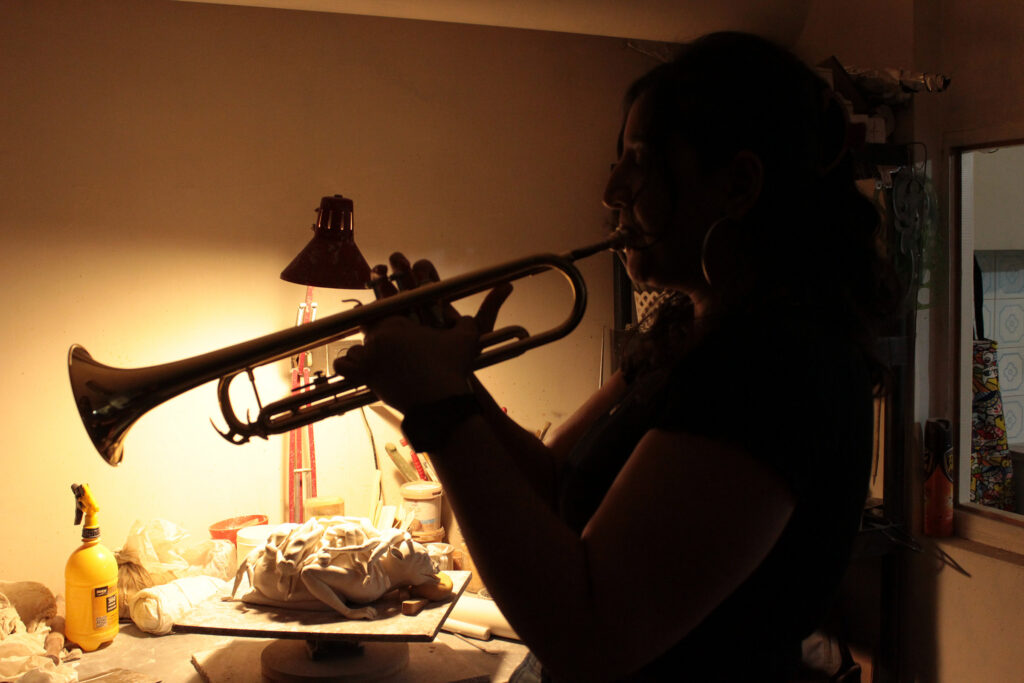
Hanane had brewed tea in the middle of all that chaos and even filled their coffee table with pastries and fruits. Over the past year, painting had become her full-time job. She told me about the rainbow in the sky that day and how happy she was that she had recently managed to achieve the aroma and flavor she had been searching for in her kotlet recipe. Besides that, she had picked up her trumpet and, under the shadow of fighter jets, discovered that she could play the soundtrack from Cinema Paradiso and a short piece by Tchaikovsky. I explained my idea for recovering memories and asked, “Hanane, didn’t any of your paintings bring back a memory?”
“Yes. There’s one. When I saw a photograph of it, I remembered how, after finishing it, I kept admiring it, thinking to myself, ‘How did you even paint this?’ I felt it was so different from my other work. I kept looking at it and thinking, ‘I wish I’d kept this one for myself.’ You know when you cry—when your eyes have been watering for a really long time—afterward your vision gets this particular quality. It’s as if everything looks bluer, or as if you’re seeing everything through rainy weather, and if you look at a light, it dazzles you. I feel like, in that painting, I arrived at this completely unintentionally. I called it Watching After Crying. I don’t remember ever giving another one of my works a name.”
My eyes were on my notebook, and I didn’t notice that she was trying to call Nima. Like a therapist, I asked, “Wasn’t there another work that brought back a memory?”
Hanane, staring at Nima’s name on the screen of her phone, said, “There’s one piece. I don’t know why I hate it so much. I remember it was huge and couldn’t fit through the front door. I think I had to use the overhead crane to pull it up from the courtyard to the rooftop and work in our rooftop studio. The rooftop studio is just a four-walled room; it doesn’t have much equipment. I remember having to buy a light and tidy the place up a bit. It was really cold too. It was as if it had been a commission, because I was pushing myself so hard. I’d work for 15 minutes and then be out of breath. I really don’t remember what happened to make me feel that way. I only remember that there was heavy snow and rain, and I couldn’t listen to music either.”
I remembered that Mahmoud had also said he hadn’t been able to work since last winter. I asked, “Didn’t you notice anything strange in your work?”
“Actually, yes. I realized that the mountains I’ve painted recently are much sharper and more cutting. They have these red colors and these harsh traces. I also saw some things in my paintings. I can’t tell what they are. They’re rectangular prisms, some of them deformed. To me, they look more like graves.” Nima turned the key in the lock. He said hello, poured himself some tea, and came to sit beside Hanane.
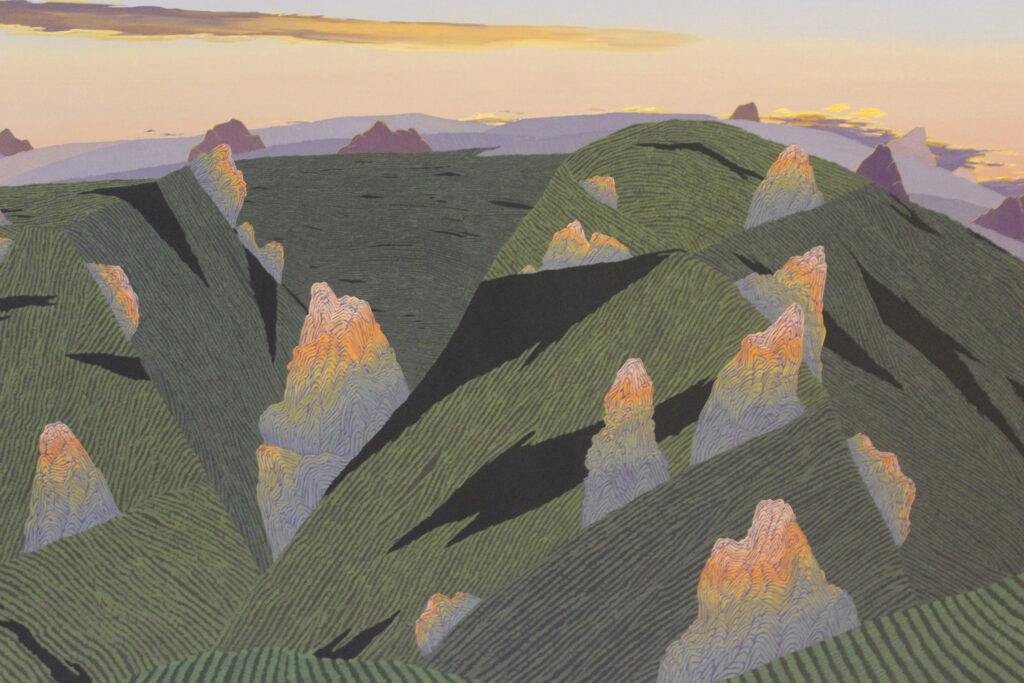
I hadn’t seen Nima in two years, and I pointlessly searched his face for some kind of change. Hanane explained that she had been telling me about her work and memories from the previous year. “Did you tell him about the trip last year too?” I looked at Hanane again. She said she would never forget that trip. She remembered that her eyes had hurt from looking at the beauty of the Poldokhtar–Andimeshk road and the mountains and hills of Darreh Shahr. She said the perspectives of the landscapes there were so strange that it was difficult to distinguish the surface of the ground from the surface of the mountains. She remembered all of this through her paintings. Nima agreed that it seemed to have been the first time he had ever grown tired from looking at beauty. They remembered tasting, for the first time, the flavors of Pattaya, caviar, and local Ilam kebabs. Memories of the previous year were returning to Nima, but he said nothing. Hanane talked about the cities, villages, and roads of Ilam, and her passion for driving; about how her driving skills were the only good thing she had inherited from her father; about watching distant landscapes from inside her father’s truck when she was perhaps ten years old; and about how much she loved the truck’s mirror because it showed the entire landscape behind you.
“Nima, by the way, have you been able to work during all this?” Nima showed me photographs of his work. He had created figures whose pain and pleasure were intertwined. Fragmented, piled-up bodies; obscene creatures with open mouths; naked, primitive pleasure and violence; and self-tormenting geometric forms.
“Looking at these—did they bring back any memory or thought?”
“Actually, I remembered that I made some things so I wouldn’t think about the past. I mean, so I wouldn’t think about anything at all. I have one piece whose form is a clay cone, with no paint or glaze. It’s the color of raw clay. When I saw it, I felt like a child who had been handed a toy or a Lego. I wasn’t thinking about the future or the past. It has no name and no color. It doesn’t resemble anything and doesn’t refer to anything. You can move it around and play with it, but because it’s ceramic and fragile, you’re afraid it’ll break in your hand. That anxiety and fear of breaking keeps you completely focused on the moment when you’re messing around with it.” Hanane stood up and went to the kitchen.
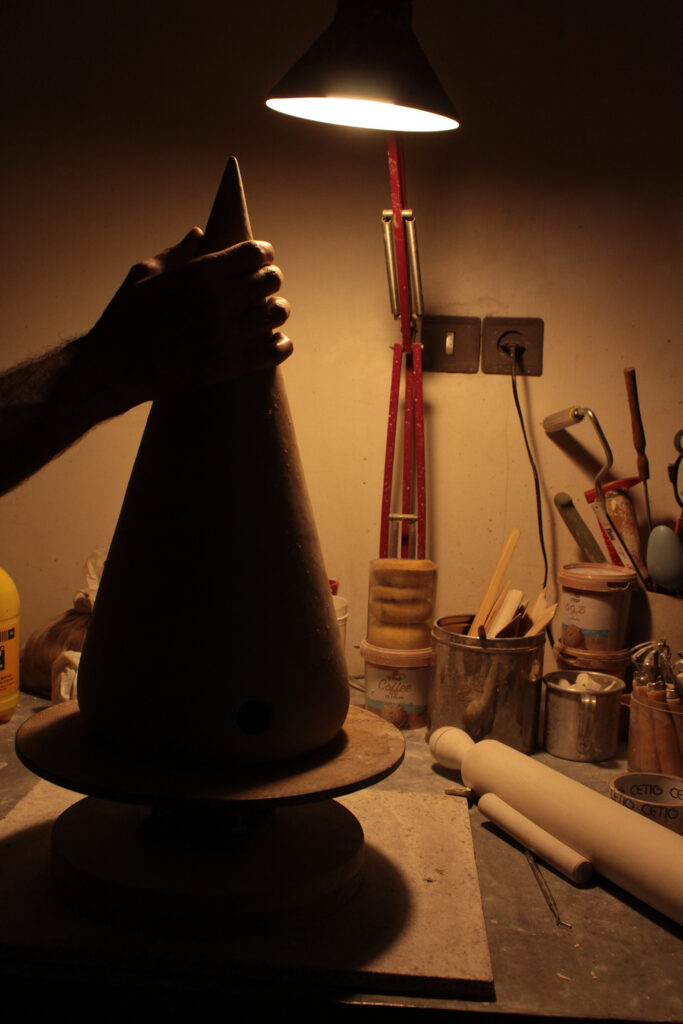
“Hanane said you stayed home throughout the war. Why didn’t you go somewhere else?” Still striking the gas lighter, Hanane called out in a clear, ringing, voice, “I don’t want to go anywhere. I remember sticking my head out the window, looking at the street, and thinking, ‘How happy I am that I’m still in Iran, that I’m still here!’” Nima added, “I was born and raised right here, on this very floor. This is our family apartment. It’s the same age as me, and in a way it’s one of my family members. My grandfather built it with his own hands. Fortunately or unfortunately, I was raised from childhood to always take care of this building. I don’t know—always checking the pipes, checking the building’s electricity and the air-conditioner water lines and pipes. Everything in this building is my responsibility and my father’s. It’s very hard for me to leave this house.” The sound of the gas lighter continued. “But in the middle of the war, my overthinking reached a point where I went and got a passport. I thought maybe we could get out overland through Turkey, just so we’d at least survive.” Nima went into the kitchen and glanced at the gas burners. It took him less than a minute to fix the lighter, and they both returned with cups of tea in their hands.
“Guys, do you remember the day the war started?” “Yes,” said Hanane. “Nima was at work. I was lying on the bed, scrolling on my phone. I wanted to go make coffee. I was walking from the bedroom to the kitchen when the sounds started. The windows were shaking. I had a glass in my hand, and I was moving like this.” She shook her body, making the cup of tea in her hand tremble. “I was thinking, ‘Should I get dressed now? Should I run? Where should I go? What happened?’ I came to my senses and rushed back into the room. I called Nima and said, ‘I think they’ve attacked us!’ Nima said, ‘Are you sure?’ He said maybe they were testing some new anti-aircraft system. I hung up, opened the window, put on the coffee, and checked my phone. I looked at the street again and saw people crying and running! I called Nima again and said, ‘The war has started.’” Hanane had encountered the event itself before hearing any news. Nima said they had expected a war, but not for it to begin only a few blocks away. Somehow, he managed to get home by around one in the afternoon, and from 9 Esfand [28 February] until 2 Farvardin [22 March], he didn’t set foot outside the house. “On the second [day] of Farvardin, I had to leave the house to get gas, buy some things from the pharmacy, and withdraw some cash from an ATM.”
Hanane said that after the second time their neighborhood had been attacked with bunker-buster bombs, just a few blocks away, she could no longer sleep properly. Every day, at exactly the same hours—around three or four in the morning—she would wake up with a start. “We slept in the basement, and when we got up we were incredibly groggy and exhausted. It was hard to climb four floors just to have breakfast and coffee. In between, they’d keep hitting somewhere, and we’d run back down. We’d stand in the middle of the apartment just long enough to make coffee. There was no internet, so we couldn’t find out what had happened or where they had hit the night before.” Nima continued, “One thing that was really disturbing was hearing a fighter jet directly overhead and not knowing where it was. And the sound of the explosion would either take forever to arrive or never come at all. The sound of a fighter jet is different from a missile. A missile sounds like this!” He imitated the sound of a missile. “But a fighter jet has a frequency—you can’t tell whether it’s directly above you or five neighborhoods away. When there was no explosion at all, we’d go crazy. We’d be thinking, ‘Did it hit the apartment next door? The one downstairs? Is it passing by?’”
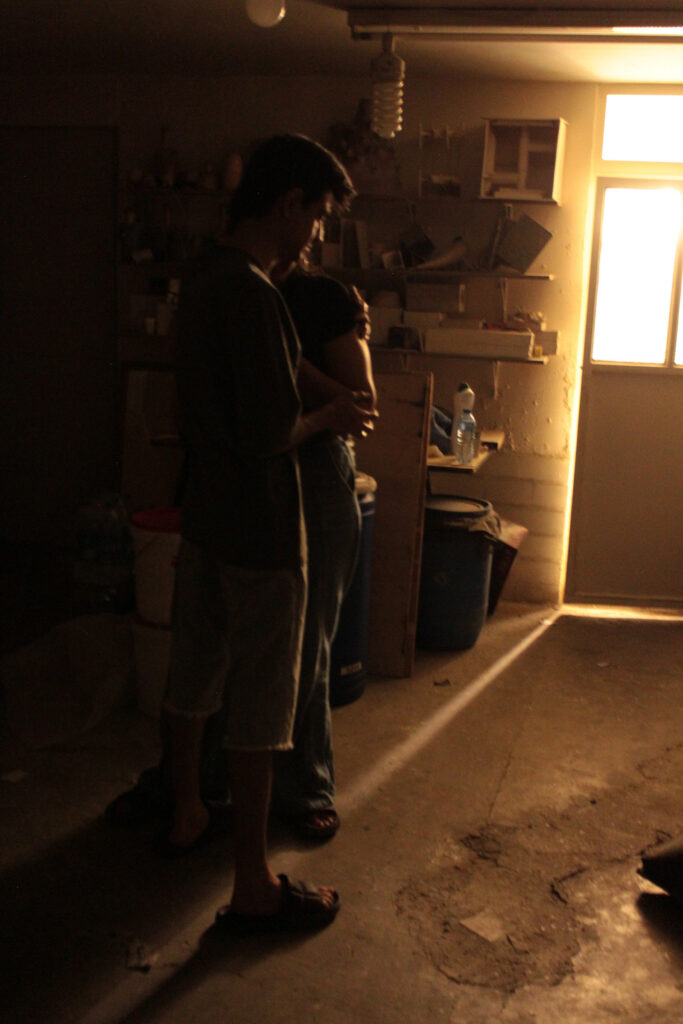
Although I had always been rootless, I could imagine how difficult it would be to leave the home where you had spent your entire life, where your parents still needed you. The two of them had spent the entire war sheltering in the basement of that house. In the early hours of 17 Esfand [8 March], Nima had woken up, climbed four floors, and looked out the window. He had seen a monstrous shadow, like a shapeless beast, swallowing the memory of the sun and crawling toward them. He woke up everyone in the building, closed the air-conditioning vents on every floor, and didn’t open the window latches for an entire week. The only result of his efforts was that they fell asleep later than everyone else and spent the entire day in absolute darkness. And, of course, they now remembered fragments of their painful pasts. Nima was satisfied about this, but Hanane would have preferred not to remember any cursed memories at all.
I asked them about their dream that day. Hanane and Nima had also had almost the same dream: Nima was in the courtyard of a house they had built in the gardens of Tarasht, working on his largest piece, which covered walls seven or eight meters high. Hanane had loaded several of her canvases into her Toyota Hilux to take them to galleries in the north. Their archive of work at home had been larger and more professional than the archive of the Museum of Contemporary Art. Hanane had driven all day and spent the night in a large house in Anzali; a house separated from a French-style boulevard by tall pine trees covered with purple climbing flowers, with a winding corridor and a path leading from the back garden to the pier. They hadn’t yet finished describing their dream when someone knocked on the door. Nima went to answer it.
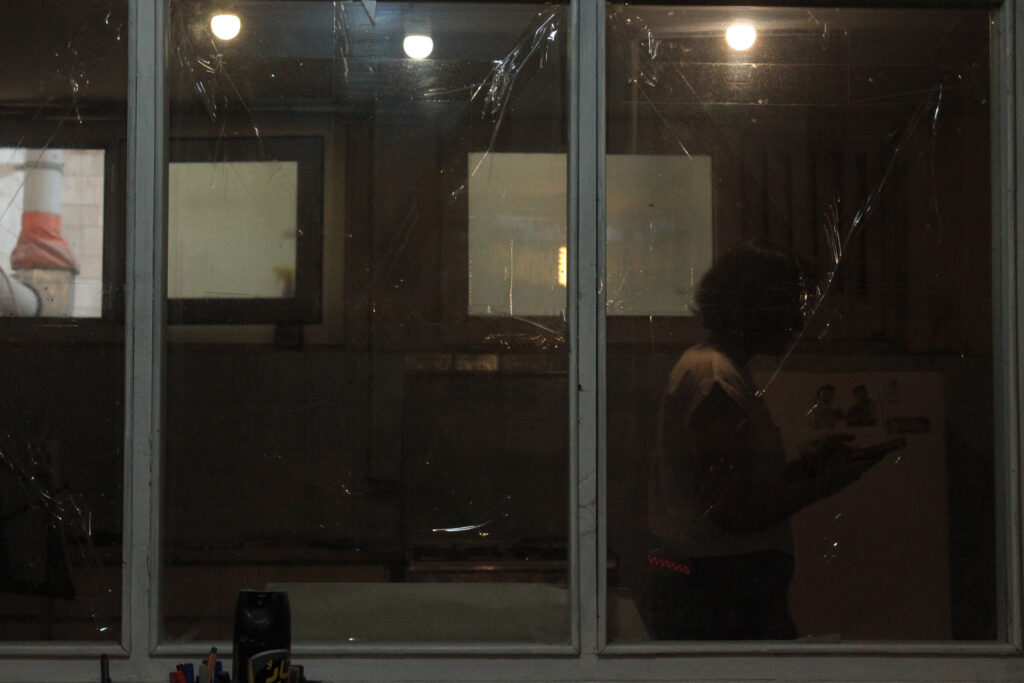
A shadow fell behind the door, its hands moving. Nima raised his fingers several times as though lifting a drop of water, then casually opened his hand. He shook his head several times, brought his fingers closer together, and moved them toward his mouth a few times. The shadow moved away from the door. Nima returned and said that his father had seen on television that several people had confidently announced that the final explosion would happen that night. The three of us laughed in a way that pretended the news was not important. Hanane wanted to set dinner on the table. I apologized and made an excuse that Negar was waiting for me. I picked up my backpack, and only then did its weight remind me why I had sought them out. I took out the insect-eater statue. “Nima, do you remember this? Do you remember what it was?” Nima frowned and said that the piece was an adaptation of ancient pottery vessels that had been used thousands of years ago to hold wine inside their bellies. He said he could wire its skull back together and reconstruct it. I hugged him, left the figure and its shattered skull fragments there, and hurried toward my car.
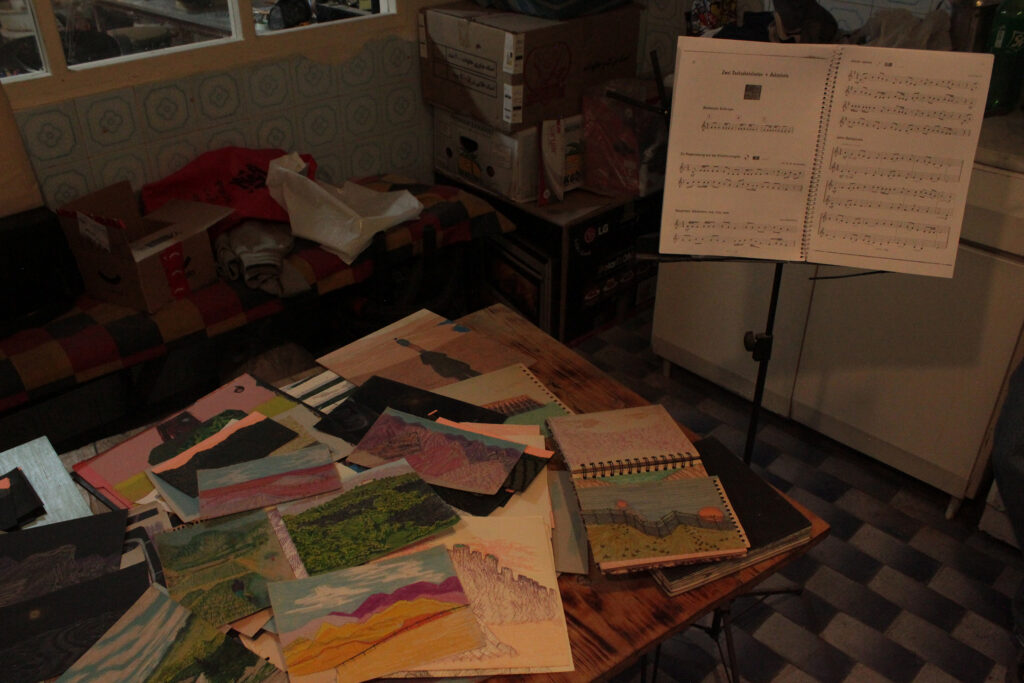
I turned the key and heard Negar’s voice, as though she were trying to reassure her father over the phone. In her sad, trembling voice, she was telling him that this was just another bluff and that nothing was going to happen. I sat beside her on the sofa and waited for their conversation to end. I thought about how Negar, Mahmoud, Ameen, Hasti, Hanane, Nima, and I had all sat on this sofa at one time or another. It was as though this object connected all of us. A wooden frame containing four photographs of Ameen and a Don DeLillo novel sat on the table in front of the sofa. When her call ended, I said, “Why do you think we want so badly to be home when we die?”
“Can you not talk like this right now?”
“I’m not joking! Every person I’ve talked to during this time has only wanted to be at home. Wouldn’t it have made more sense to go somewhere out in nature and wait for things to settle down? Or even leave Iran and come back when the war was over?”
“So you think something’s going to happen tonight?”
“No way. It’s all a game.”
“I wish the internet hadn’t been cut off and we’d applied earlier. We could be in Amsterdam by now. But if we were there, I’d die of anxiety over my dad. What did Hanane and Nima say? Did you find out anything new?”
“Yeah. It seems they had the same dream as us too. But I feel like my effort is pointless. Rearranging reality is useless because everyone remembers the past in their own way. The only thing I’ve realized is that we don’t talk to each other at all. I mean, we know almost nothing about the lives of the people we know. This loneliness, this feeling of being unseen, makes us feel like strangers in our own homes. As if our existence doesn’t matter at all.”
“Well, things aren’t exactly in a state where people can see their friends right now. It’s normal.”
“Exactly! But we don’t even remember when things became this way!”
Negar sighed. She said she had found the picture frame and the book underneath the sofa while vacuuming. It was approaching midnight. Somewhere deep down, we thought it was possible that everything really would end that night with one enormous explosion. We stretched out on the sofa. We took turns reading a few pages of the novel, and fell asleep right there.
That night, a boy with his strange stringed instrument walked through the streets of Tehran. His head was bowed, and the waterfall of his hair rippled across his bony face with every step. He was a prophet with eyes no one would have dared to meet, even in a dream. He stopped on bridges and shouted strange incantations: “I will show you fear in a handful of dust.” Dragging himself along, he reached the foot of Azadi Tower, drew something resembling a fan across his instrument, and played his final melody. In a dead voice, he repeated: