In two selected paintings by Leyli Rashidirauf, Katayoon Barzegar reads two distinct states of observing war from afar: the shock following the attack and its sedimentation into everyday life.
During a visit to Rashidirauf’s studio in Amsterdam, we selected two works, in consultation with the artist, for the first issue of Fāsh. Her recent works, shaped by the war in Iran, bear traces of home and migration—the central themes of the first issue of Fāsh. The first painting, created during the summer of 2025 at the start of the Twelve-Day War, depicts a neighborhood engulfed in thick smoke. The second was painted several months later, reflecting the bitter routines of migration amid intense anxiety and grief. Yet rather than merely representing an external event, both works are more concerned with the artist’s psychological experience of inhabiting the vast gap between her physical, lived environment and her inner world—the gap between what unfolds within her and what the world outside demands of her.
The following essay is a brief wandering through the conceptual and visual layers of these two works, focusing on the ways in which the artist records her experience of the complex situation she was trapped in. Both selected works capture a similar condition, but at two different moments and in two distinct states. One speaks of the shock of the initial encounter with war; the other, of its sedimentation into everyday life and the human psyche. Both works speak to the state of an artist who looks at home from a distance, with a sense of bewilderment.
I. I Pity the Garden
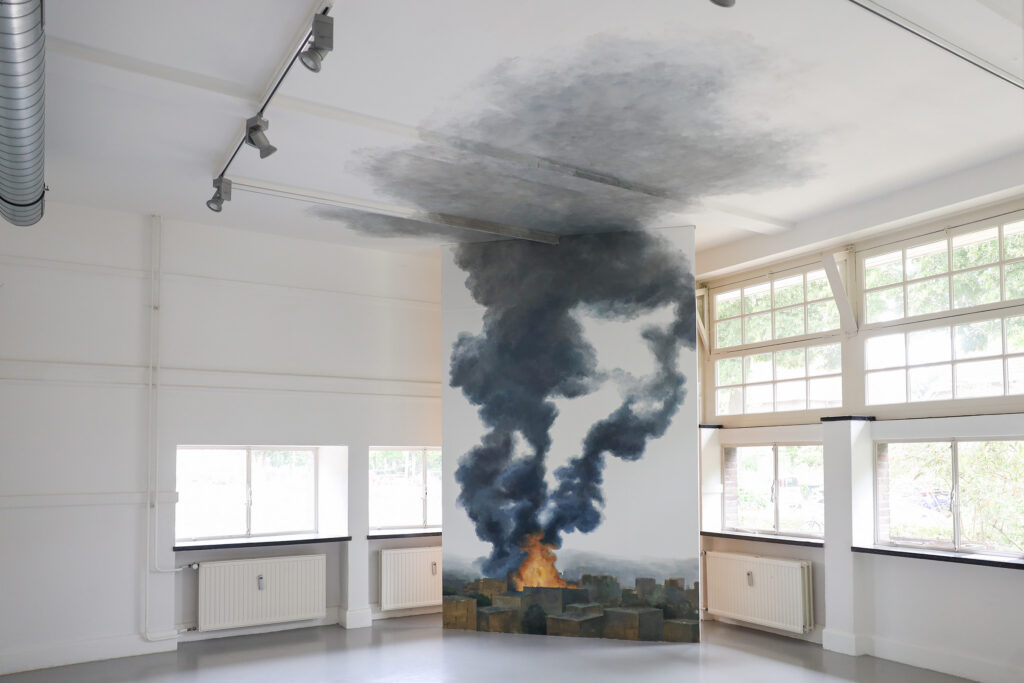
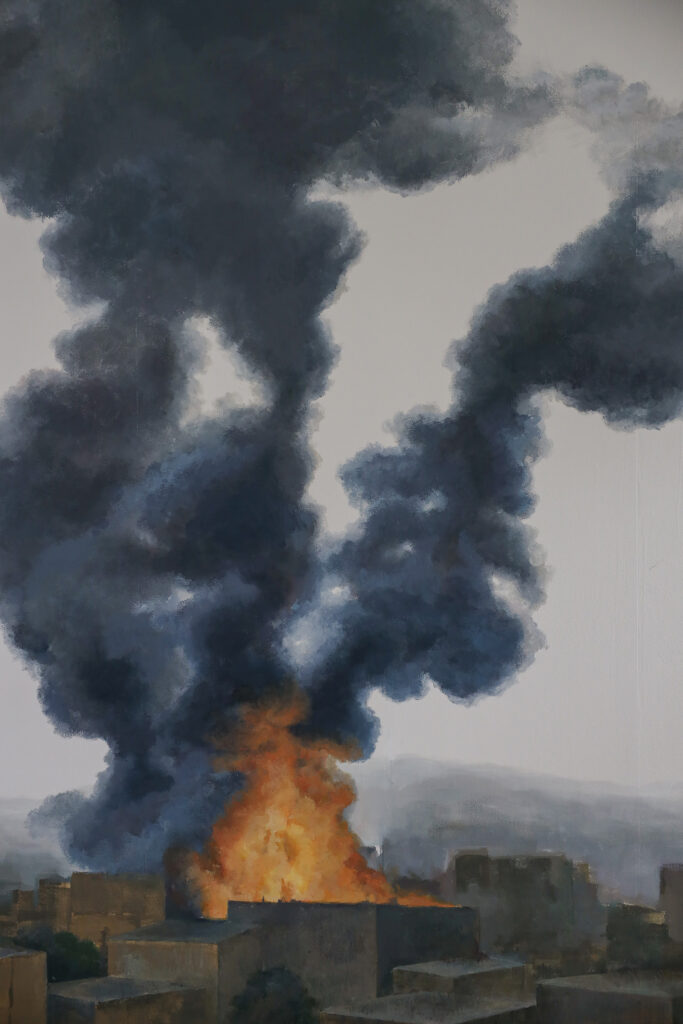
I Long for the Garden
Site-specific mural
Acrylic on wood panel and ceiling, 2025
For Leyli Rashidirauf, the first image of the Twelve-Day War was one of thick, black smoke—a sticky smoke that rose into the air and seemed to occupy the entire space above her head. It was the same smoke she saw in the first image of the bombings that reached her on her phone screen, as she stared at its movement, stunned and transfixed. The image of war reached her at the smallest possible scale, yet very quickly became the largest image in her mind—so much so that no other image could diminish the presence of that smoke. This was the first war she had ever experienced, and although she was physically outside it, she saw herself as being inside it. Like many other migrants, Rashidirauf had to continue her everyday life in a geography far removed from the turmoil, while at the same time witnessing the war from a physical distance.
She was soon due to travel to an artist residency in the south of the Netherlands that had been arranged before the war began. For two weeks, she was to live and work there with Dalal Mitwally. Mitwally is a Jordanian artist. Her lived experience was close to Rashidirauf’s, which made it easier for Rashidirauf to share her newfound anxieties, intense distress, and the profound contradiction that the war had introduced into her everyday life. At that moment, Mitwally understood that Rashidirauf’s mind was entirely occupied by the war and was unable to focus on anything else. As a result, the subject of their collaborative work became clear to them before they arrived at the residency.
Rashidirauf is a painter, having moved to the Netherlands after years of professional practice in Tehran. Since migrating to the Netherlands, Rashidirauf’s artistic practice has sought to shift the boundaries of painting itself, responding to the interdisciplinary context that characterizes much of the Northern European art scene. Although this transition was by no means an easy undertaking, Rashidirauf would gradually find a sense of pleasure in this practice in transition. In collaboration with Mitwally, she continued this attempt to expand the boundaries of painting. Not only did Rashidirauf move beyond the traditional boundaries of the canvas, she also extended part of the production process beyond the studio itself. As a result, both the final work and the process through which it took shape became entangled with their surrounding environment.
The first days of Mitwally and Rashidirauf’s collaboration were dedicated to long conversations about their everyday feelings. At times, they read poetry together, each translating for the other when necessary. Even in moments of silence, they wrote letters to one another, extending this shared process of reciprocity and emotional release into written form. As they wandered through the city of Eindhoven, they began to think about how they might involve this quiet city in their thoughts and state of mind. They felt a strange and almost unbearable contradiction between the world outside and what was happening within them, and wanted to let their troubled state seep into the city—a city whose inhabitants perhaps imagined that war would never come to them.
Eventually, after repeated conversations and exchanges of letters, they began searching through their everyday writings for short sentences that could capture their state of mind. They then printed the selected sentences in Persian, Arabic, and English onto sheets of paper, intending to paste them on the doors and walls of the city: “I couldn’t sleep last night.” “What if the smoke covers everything?” “How do I breathe?” “I hate this feeling of helplessness.”
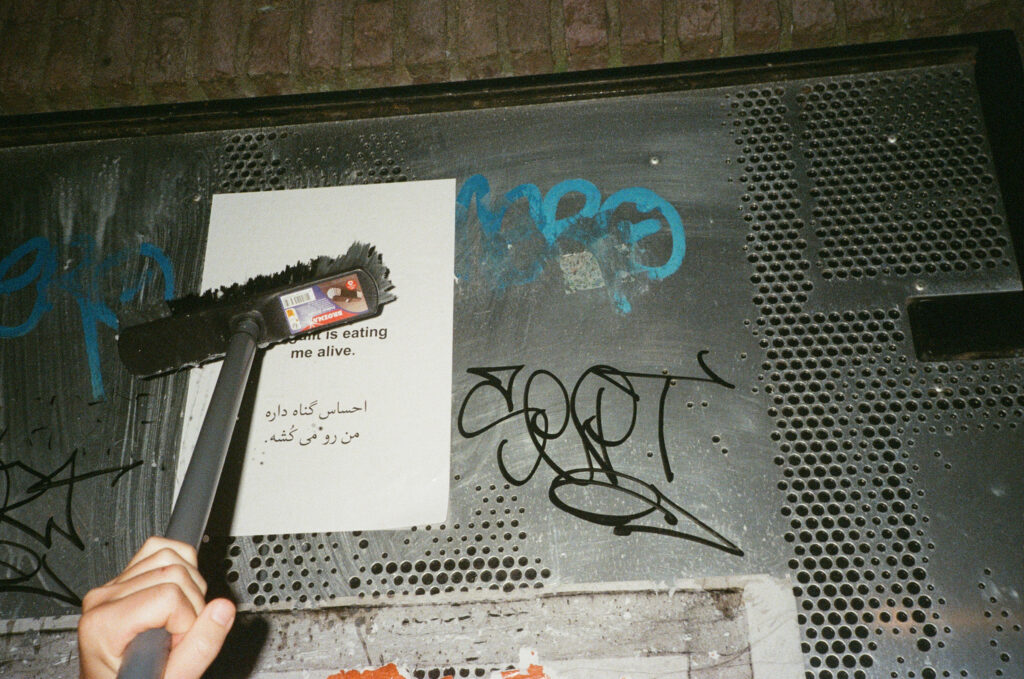
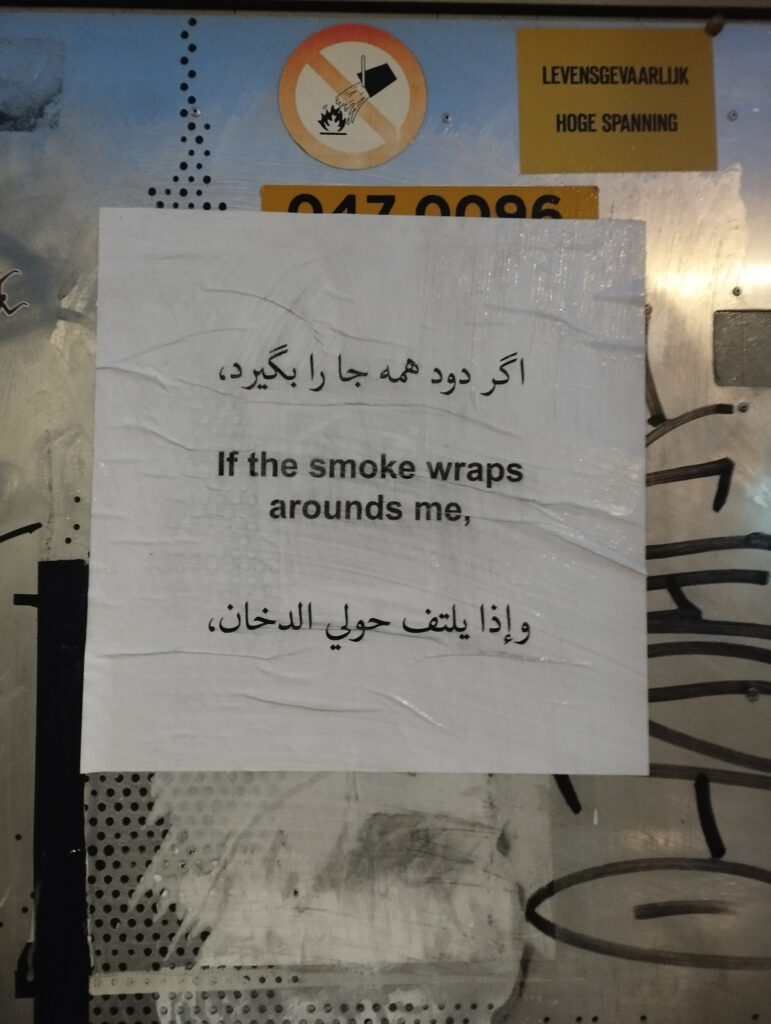
Yet among all those words and letters, it was Forough Farrokhzad’s poem, “I Pity the Garden” [Delam Baraye Baghcheh Misoozad], which resonated with them more deeply than anything else. Farrokhzad’s poem speaks of the decline of a garden, and for both of them, it became a reflection of what they were experiencing in those days. For this reason, drawing on Farrokhzad’s poem, they titled their work I Pity the Garden.
After several days of exchanging words and taking short walks through the city as a way of releasing their emotions, Rashidirauf began painting the smoke that had filled her mind and that she wanted to expel. She found a large wooden panel at the residency and began to record the state she was in. She knew that smoke would be the central element of the painting. For this reason, she paid less attention to the houses and other elements of the city, devoting most of the painting to the city’s sky and the smoke suspended within it.
In a short period of time, with broad, sweeping brushstrokes, Rashidirauf filled the surface of the multilayered wooden panel with blackness. But she was not satisfied with filling the two-dimensional surface alone. She knew that she wanted to involve the space more fully than ever before. She wanted to convey the sensation of a dense mass invading the space and to draw the viewer’s attention beyond the two-dimensional frame of the painting. So she continued the dense smoke upward, filling the space between the wooden panel and the ceiling. The continuation of that grey density onto the ceiling created a new spatial condition. Now, in order to follow the painting, the viewer had to raise their head.
It recalls the physical experience embedded in the Persian expression balā be sar-e kasi āmadan—literally meaning, “a calamity befalling someone,”—an expression used when a sudden misfortune strikes. It is one of those expressions that invokes a bodily condition to describe an experience or situation.
Rashidirauf has been trying to articulate what has happened to her: a state of stunned disbelief following a heavy assault. It is as though she records the moment of catastrophe at the same distance from which she received it—a distant witness to the war, transfixed by what she sees. From this distance, Rashidirauf sees a dense blackness that refuses to dissolve. Smoke that, contrary to its natural state, does not dissipate into the air. It is so dense that it does not disappear. It is sticky. It surrounds you, envelops you, and refuses to let you go.
II. The Pastries I Packaged
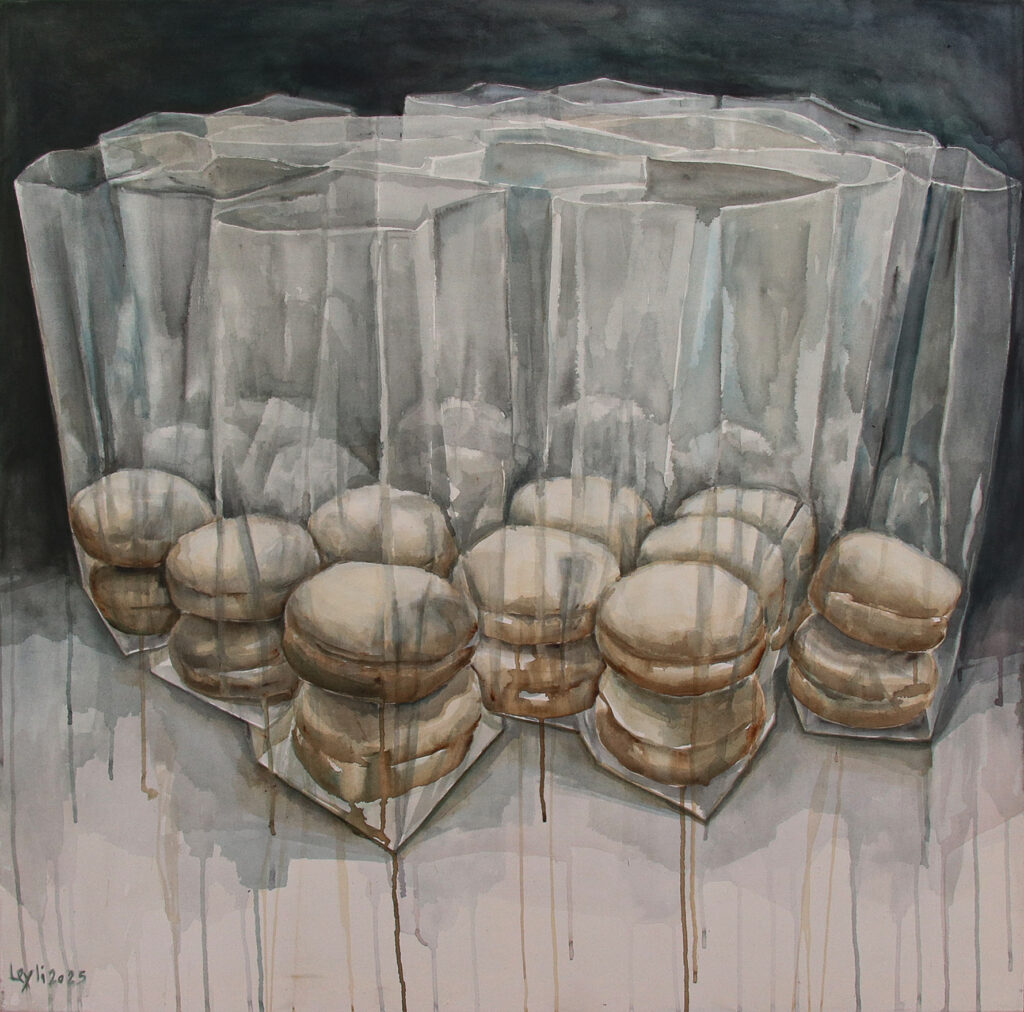
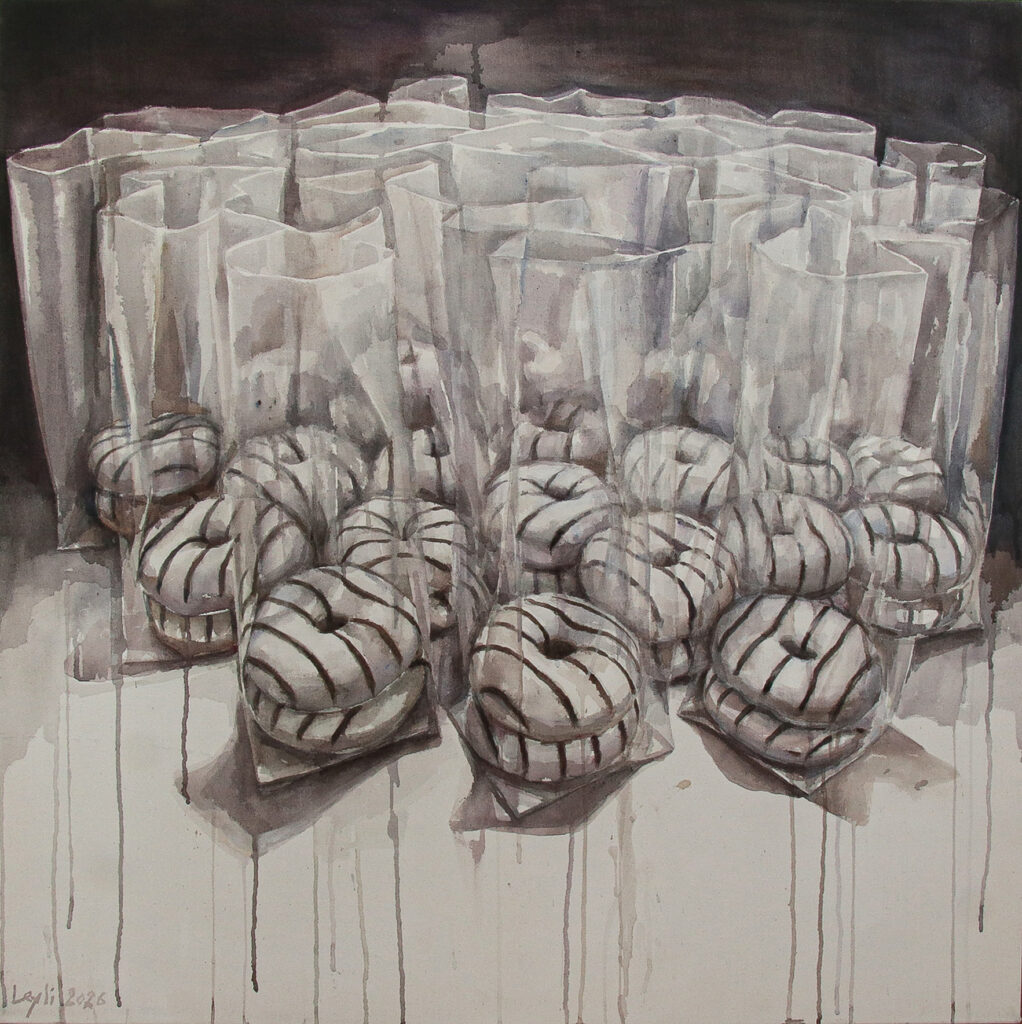
From the series The Sweets I Packaged
Acrylic on canvas, 95 × 95 cm
2025–2026
For several months, Rashidirauf worked in the bakery section of Albert Heijn in one of Amsterdam’s older neighborhoods. Albert Heijn is a Dutch supermarket chain, and, for Rashidirauf, even learning how to pronounce its name felt unfamiliar—much like the Dutch language itself, and many other things that might never fully become ordinary to her. Early each morning, she would go to the supermarket’s bakery section, where she took pre-made dough out of the freezer and placed it in the ovens according to precise timings. Once baked, Rashidirauf packaged the pastries and, using a small machine to print their expiration dates, would stick them onto the plastic packages. As she went about her daily tasks, she overheard two colleagues talking loudly, in Dutch, throughout the entire shift. She understood nothing of their conversation—and even if she had, it was probably so far removed from the world occupying her mind that she would have preferred not to hear it.
During the war, Rashidirauf found it impossible to resist the compulsion to obsessively check the news on her phone. Rumination and anxiety; compounded by internet shutdowns, a lack of information, and sleeplessness; had made everyday life that much more difficult. Rashidirauf struggled to concentrate on her work. Being held accountable to a boss was the last thing she could tolerate. Even after the Twelve-Day War, Rashidirauf continued to feel a profound rupture in her work environment. Her limited physical energy, and emotional capacity, compromised her ability to endure it for long. Soon, she resigned.
The only significant thing she took away from that place was a series of photographs she had taken during her breaks—photographs of plastic packages filled with pastries fresh from the oven. When the other employees went out for lunch, Rashidirauf would sit alone in silence, closely examining these packages. After hours of staring at their details and seeing the same packaging repeated over and over, she began photographing them, without knowing exactly why she was achieving them.
A day after resigning, while restlessly scrolling through photographs from her last trip to Tehran, she came across the pastry images. At that moment, she sensed the emptiness embedded in them. Recalling those hours at work, she remembered how her eyes had involuntarily lingered on seemingly insignificant details: the colors, the reflections of light on the plastic, and the arrangement of identical packages. It was her painterly gaze that allowed Rashidirauf to perceive the exhaustion produced by repetition and the banality of everyday life not as abstract concepts, but through these very mundane details. Archiving these images, before she had even decided to turn them into an artwork, was a continuation of a particular way of seeing that she had developed over years of painting.
The Pastries I Packaged is composed of muted, neutral greys that convey the atmosphere of those days to the viewer. In contrast to the warmth and sweet smell of the pastries released into the space when the plastic packages were opened, Rashidirauf’s painting evokes the bitterness of migration and the difficulty of starting again from zero—a reminder of all the circumstances that pushed her to leave home. Every day, while packaging the pastries, she would ask herself, “Why did I leave?” The work carries the weight and repetition contained in this simple question. It is as though time has come to a standstill within it—a stillness very different from the elevated serenity of Dutch Baroque still life paintings, in which ordinary foodstuffs are delicately arranged on a table under golden light.
Rashidirauf’s choice of subject recalls the tradition of still life painting in 17th century Netherlands, which observes and records everyday objects with meticulous attention. She looks at the repetitive plastic packages of pastries with the same attentiveness of a 17th century Dutch painter looking at everyday objects. Common to each of these modalities of the visible is a particularly meditative quality, examining and recording commonplace things with precision. And yet, whereas the arrangements depicted in early still life paintings symbolize abundance, order, and, perhaps, a contemplation of everyday life’s details, in Rashidirauf’s work, this same gaze becomes a means of confronting the exhaustion of daily life, the bitterness of migration, and the distance from home.
The process and nature of recording the war in these two selected works by Rashidirauf posses a particular quality. She does not seek to directly represent the war, nor does she attempt to impose a personal narrative upon it. Rather, Rashidirauf records her encounter with the war itself—an experience that may resonate with that of many other migrants. In doing so, she captures a reflection of the confusion and disorientation of our time. Rashidirauf’s artistic response to remembering this complicated condition lies in making visible the profound exhaustion and disorientation that emerge through everyday forms of suffering that often go unnoticed—the kind of suffering that has little to no place in official archives or the news and cannot be contained in statistics or numbers.
Rashidirauf records invisible experiences that emerge, not from the event itself, but from the ongoing experience of living in its shadow. These experiences are neither black nor white, but exist somewhere along a spectrum of grey, much like the “pastries” and “smoke” that serve as the central elements in the two selected works. Each piece records the same condition at a different moment: one at the moment when smoke covers everything; the other when the grey of that smoke has settled into everyday life. It is as though the drips of paint in The Pastries I Packaged render this sedimentation visible. Slowly, the image Rashidirauf had of her new life and migration begins to fade, giving way to the reality before her—to the point where, even when “the sound of things breaking comes from behind the door,” she must continue packaging the pastries.
“Our garden is forlorn
Our garden is forlorn
All day from behind the door
come sounds of cuts and tears
sounds of blasts.
Our neighbors plant bombs and machine guns,
instead of flowers, in their garden soil.
They cover their ponds, hiding bags of gunpowder.
The schoolchildren fill their backpacks
with tiny bombs.
Our garden is dizzy.”